
Criminal Court Records in Huntingdon County
A criminal court record is the court-maintained case file, not just the arrest. In Huntingdon County, criminal records are handled through Magisterial District Courts at the early stages and the Court of Common Pleas for misdemeanor and felony case processing after transfer or filing. The Clerk of Courts side of Sarah Snare's Prothonotary / Clerk of Courts office handles criminal case filings, summary appeals, bail, bench warrants requested by the District Attorney or Probation, and reporting criminal dispositions and motor-vehicle case results to state systems.
Magisterial District Courts handle preliminary arraignments, preliminary hearings, traffic citations, and non-traffic summary offenses. The Court of Common Pleas is the trial court of general jurisdiction for major criminal cases in Judicial District 20. For a close look at charge wording and charge status before outcome, use the Huntingdon County arrest records and court charges page; this page stays focused on the full criminal case file and outcome.
How to Search Huntingdon County Criminal Court Records
Start with UJS Case Search for public criminal docket sheets. Search by defendant name, docket number, complaint number, citation number, or offense tracking number. Use Huntingdon County as the county filter when available, and check both Magisterial District Court and Court of Common Pleas if the case may have moved from preliminary proceedings to Common Pleas.
- Open the UJS case portal and choose criminal or magisterial district search options.
- Enter the defendant name, docket number, complaint number, citation number, or OTN.
- Review the court level to see whether the matter is still in MDJ court or is in Common Pleas.
- Open the docket sheet to read charges, events, bail, pleas, disposition, sentence, and costs.
- Contact the Prothonotary / Clerk of Courts for certified copies, file review, or criminal copy fees.
UJS docket sheets are not Pennsylvania State Police background checks. They show public court activity, while statewide criminal history access is governed by Pennsylvania criminal history record information law and related limited-access rules.
Huntingdon County Criminal Case Flow
Criminal records change as the case moves from complaint to final disposition. A single docket may show an arrest-related complaint, preliminary hearing, information filed by the prosecutor, formal arraignment, pretrial motions, plea, trial, sentence, restitution, costs, and later expungement or limited-access events. Bench warrants may appear if the defendant misses court or violates a court order.
Case flow: Charges Filed › Arraignment › Pretrial / Motions › Plea or Trial › Disposition › Sentencing
| Stage | What Happens |
|---|---|
| Charges Filed | A complaint or information identifies alleged offenses, statutes, grading, and defendant details. |
| Arraignment | The court advises the defendant of charges, bail, counsel, and the next required appearance. |
| Pretrial / Motions | Attorneys file motions, negotiate pleas, seek continuances, and prepare for hearing or trial. |
| Plea or Trial | The case resolves by guilty plea, negotiated plea, trial verdict, dismissal, or other disposition. |
| Sentencing | The docket may list incarceration, probation, fines, costs, restitution, conditions, or credit information. |
What a Huntingdon County Criminal Court Record Shows
Criminal docket fields should be read together. A charge line alone does not prove conviction, and a sentence line only applies to charges that reached a guilty plea, verdict, or other qualifying disposition. Huntingdon County criminal court records may also list the District Attorney, defense attorney, public defender appointment, bail activity, warrant entries, costs, restitution, and reporting events to state systems.
| Field | What It Shows |
|---|---|
| Docket Number | The Common Pleas or MDJ case identifier used for searching and certified-copy requests. |
| Defendant | The person charged, often with identifiers limited by public access rules. |
| Charges | Offense name, statute, grading, count number, and current charge status. |
| OTN | Offense tracking number tied to the criminal incident and court filing. |
| Plea | Whether the defendant entered a guilty, not guilty, or negotiated plea when shown. |
| Disposition | Outcome for each charge, including guilty, dismissed, withdrawn, acquitted, or other result. |
| Sentence | Incarceration, probation, costs, fines, restitution, conditions, or other penalties if imposed. |
District Attorney and Public Defender in Huntingdon County Criminal Cases
The Huntingdon County District Attorney is David G. Smith, with an office at 207 Washington Street. DA records requests use the Right-to-Know form, must describe records with enough specificity, and are not accepted verbally or anonymously. Copying is listed at $.25 per page, with other fees under the RTKL structure. The Public Defender office is at the courthouse and is led by Fred Gutshall, with Assistant Public Defender Lance Marshall. Applications must be mailed, faxed, or hand delivered, not emailed.
The District Attorney page is relevant because prosecutor filings shape the criminal court record.
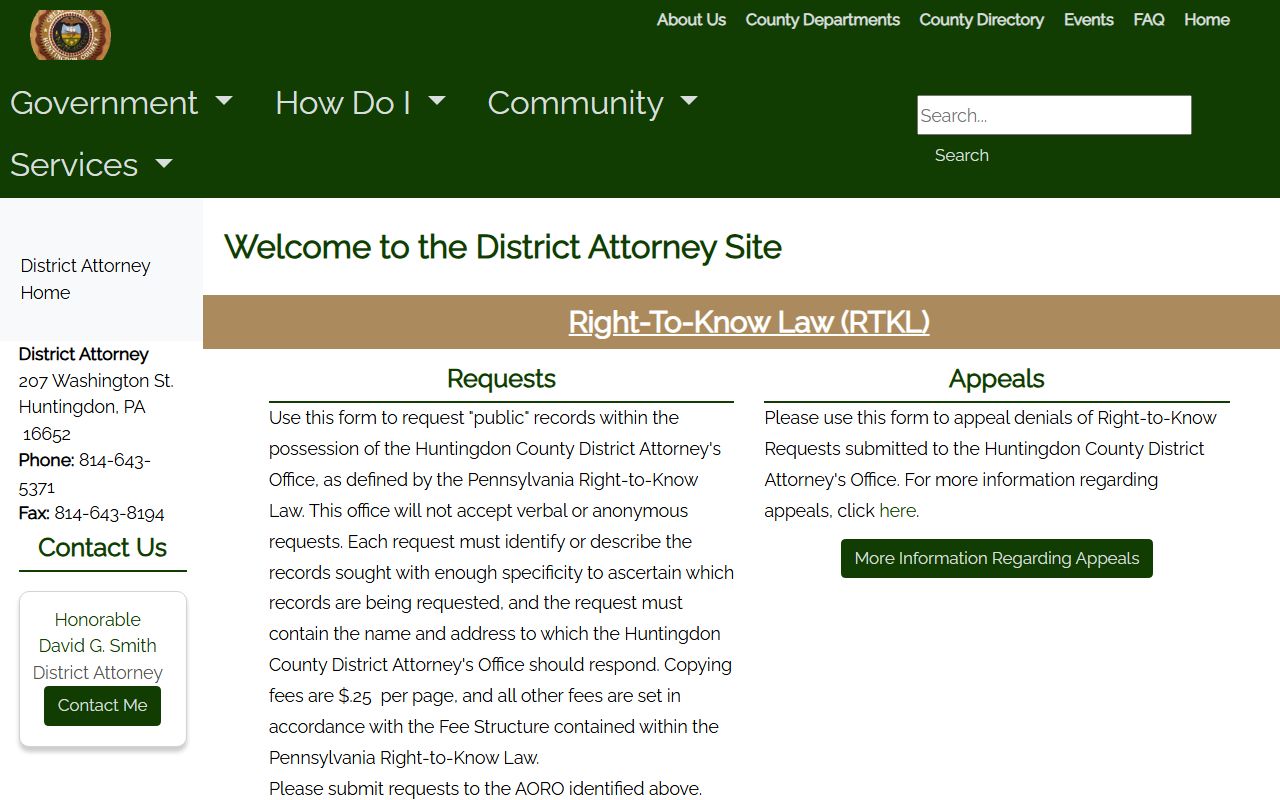
The DA's role helps explain why charging documents, plea negotiations, and dispositions appear in criminal dockets.
The Public Defender page identifies the county office for eligible defendants who need appointed counsel.
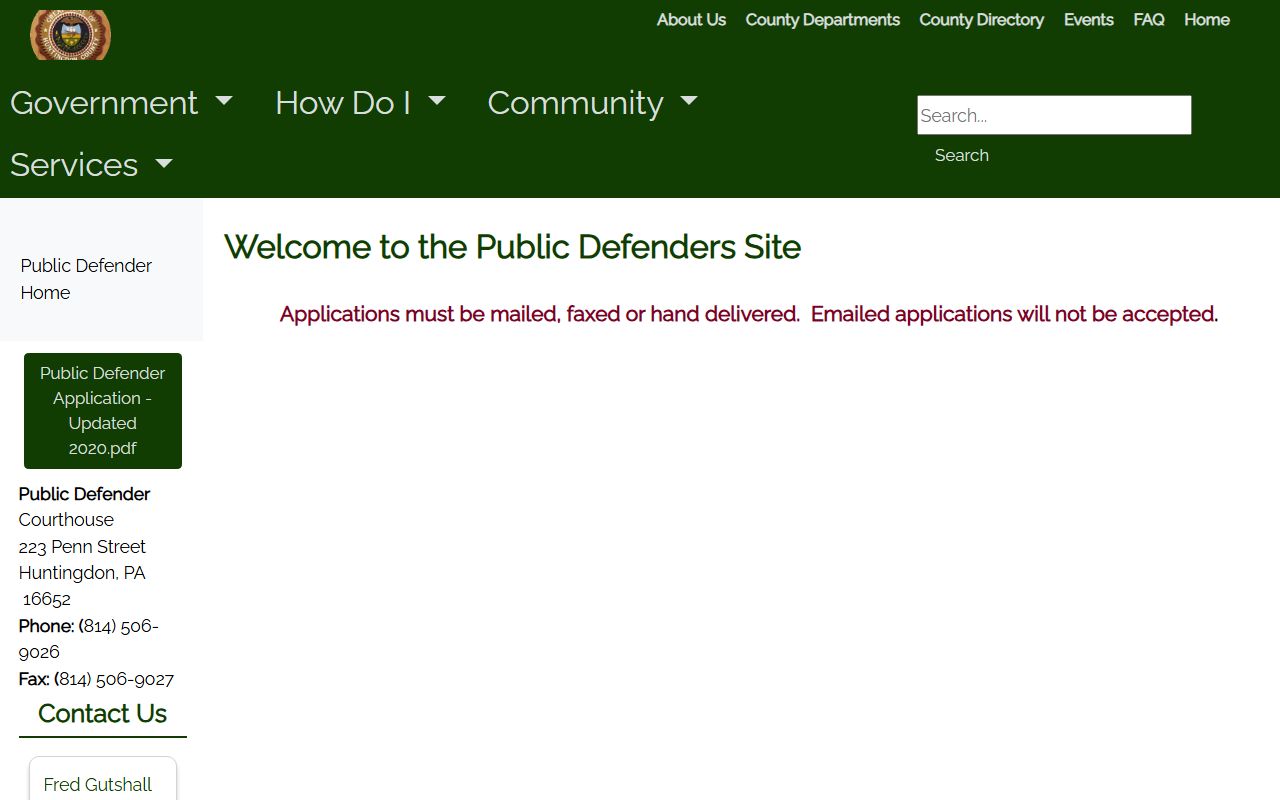
Defense representation can appear in docket entries through counsel appearance, motions, hearings, pleas, and sentencing events.
Huntingdon County Charges vs Convictions
A charge is an accusation filed in court. A conviction is a final outcome after a guilty plea, guilty verdict, or other qualifying finding. Criminal court records can show charges that were amended, reduced, withdrawn, dismissed, nolle prossed, or ended in acquittal. Read each count separately because one case can include several charges with different outcomes.
| Charge | Conviction | |
|---|---|---|
| Stage | Accusation filed by complaint or information | Final result after plea or verdict |
| Proof | Based on probable cause or prosecution filing | Requires guilty plea, trial finding, or accepted disposition |
| Record Meaning | Shows what was alleged | Shows legal responsibility for that count |
Sealed vs Expunged Criminal Court Records
Restricted criminal records may disappear from public search results or show limited information. Juvenile files are restricted under 42 Pa.C.S. section 6307. Expungement is addressed by 18 Pa.C.S. section 9122. Pennsylvania criminal history law includes limited access and clean slate provisions, which can affect what appears to the public even when law enforcement or courts retain some access.
| Sealed or Limited Access | Expunged | |
|---|---|---|
| Public Visibility | Hidden or limited for most public users | Removed from public access after legal processing |
| Government Access | May remain available to courts or justice agencies | May be limited to narrow statutory exceptions |
| Authority | Public access policy, clean slate, court order, or statute | 18 Pa.C.S. section 9122 and court processing |
The Pennsylvania expungement statute is the primary source for criminal expungement references.
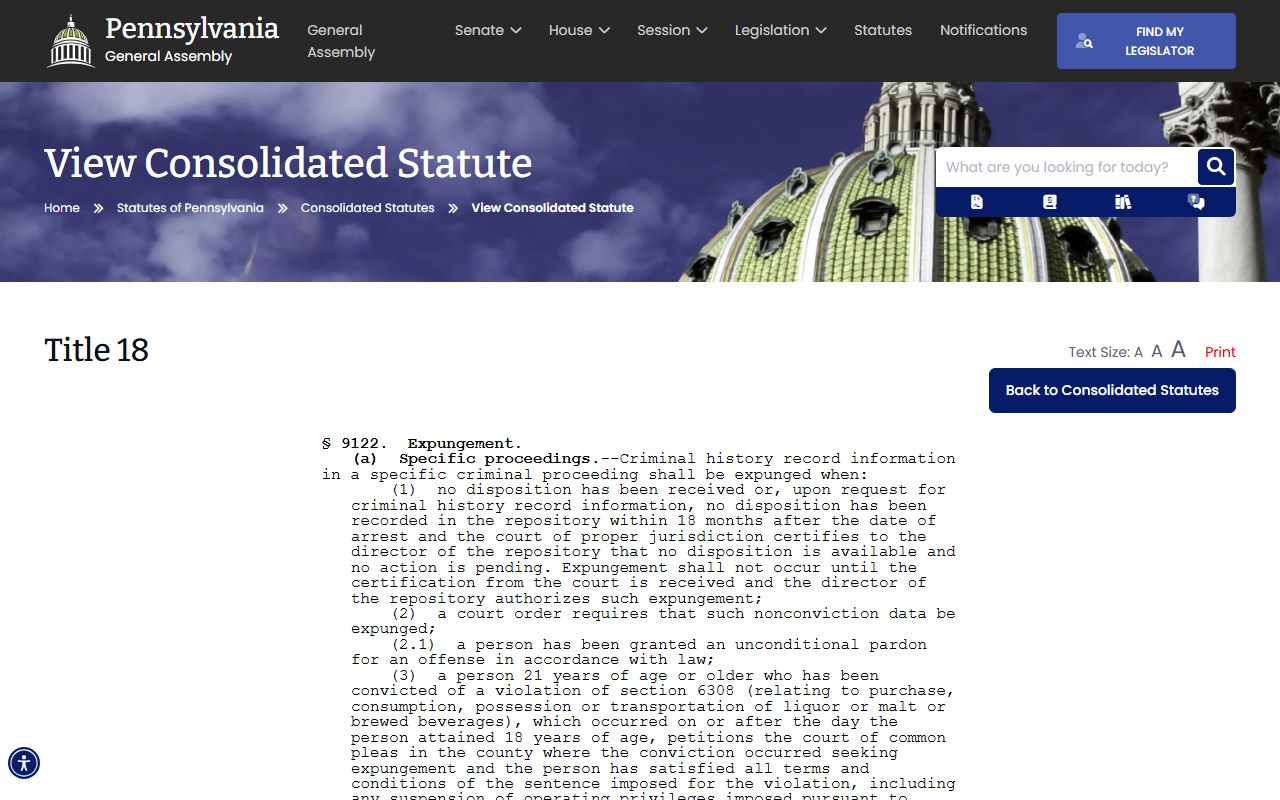
Expungement affects public lookup results, but eligibility and processing depend on the specific criminal record and court order.
Public Access to Huntingdon County Criminal Court Records
Public criminal court access in Pennsylvania is controlled by the UJS case-record public access policy and criminal record statutes. Dockets may be free online, but certified copies and file review go through the Clerk of Courts. PAePay may show eligible fines, costs, restitution, bail, and probation or parole fees, but a payment screen is not a complete criminal case file and does not replace the docket.
Key Sources: 204 Pa. Code section 213.81 controls public access to UJS case records.
18 Pa.C.S. Chapter 91 addresses criminal history record information, limited access, and clean slate provisions.
Restricted Criminal Court Records in Huntingdon County
Juvenile files, sealed cases, expunged matters, confidential identifiers, some victim information, some mental-health or dependency-related materials, and pre-execution search warrants may be restricted. If a person believes a record should exist but cannot find it, the next step is to confirm the court level, case number, name spelling, and access status with the Clerk of Courts or the issuing MDJ court. Court staff can explain filing and access procedures, but they cannot give legal advice.