
What Is a Huntingdon County Court Docket
A docket is the court's running index of a case. In Huntingdon County, docket sheets can show the case caption, docket number, court office, filing date, judge or magisterial district, parties, attorneys, docket entries, hearing events, warrants, bail, charges, disposition, sentence, payments, costs, and appeal activity. The docket helps users track what happened and where the case sits, but it does not always include every pleading, exhibit, transcript, or sealed document.
The Court of Common Pleas and Magisterial District Courts create different docket records. Common Pleas dockets cover major civil and criminal cases, family matters, appeals, and other trial-court work. MDJ dockets cover traffic citations, non-traffic summary offenses, preliminary arraignments, preliminary hearings, landlord-tenant cases, and smaller civil claims. For full file access beyond the docket, contact the office that holds the case record.
How to Find Huntingdon County Court Dockets Online
The official online route is UJS Case Search. The UJS docket sheets page cautions that docket sheets are public court records, recent entries may not appear immediately, and docket sheets are not criminal history checks. PAeDocket provides a mobile-access route described by UJS case information materials.
- Open UJS Case Search and choose the appropriate court type.
- Select Court of Common Pleas for trial-court cases or Magisterial District Court for MDJ matters.
- Enter a docket number, participant name, citation number, complaint number, or OTN.
- Filter to Huntingdon County when the search form allows county filtering.
- Review the docket entries, disposition, hearing dates, and financial lines before requesting the full file.
The UJS docket sheets explanation is the official public-access source for docket sheet limits.
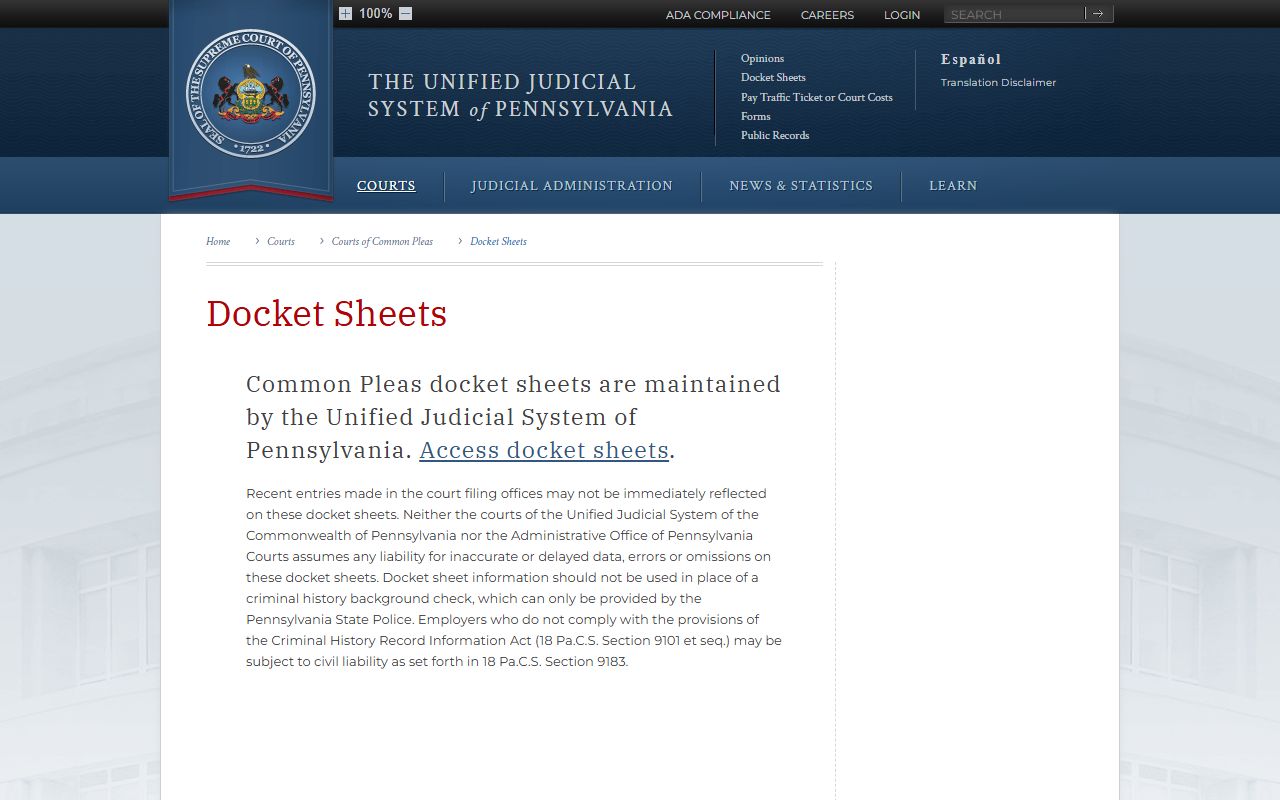
That warning matters because a docket can lag behind a courthouse action or omit confidential case material.
Sample Huntingdon County Docket Entry
A docket entry should be read as a timeline item. The date tells when the entry was filed, processed, or recorded. The event text identifies the court action. The filing party may show who submitted a document, and the entry may point to a hearing, order, judgment, charge, payment, sentence, bail change, or warrant event. If a document link is missing, the underlying paper may still exist at the courthouse.
| Field | What It Shows |
|---|---|
| Entry Date | The date the filing, order, hearing notice, disposition, payment, or warrant event was posted. |
| Event Type | The docket action, such as complaint filed, hearing scheduled, order entered, plea, sentence, or judgment. |
| Party or Office | The participant, attorney, clerk, court, DA, probation office, or filing party tied to the entry. |
| Case Number | The docket identifier used for follow-up with Common Pleas or an MDJ office. |
| Disposition | The outcome of a charge, claim, petition, citation, or appeal if the docket has reached that stage. |
| Document Access | Whether the public docket shows an entry only or whether a separate courthouse request is needed. |
Courts That Publish Huntingdon County Dockets
Huntingdon County uses Pennsylvania's statewide Unified Judicial System for public docket sheets. Court of Common Pleas records are tied to Judicial District 20 and the courthouse in Huntingdon. MDJ docket work is divided among three local districts. The June 2026 county court notice reported that MDJ Lisa Covert's 20-03-04 office moved from Orbisonia to Mount Union, so users should verify the correct district address before visiting an MDJ office.
- Court of Common Pleas: major civil, criminal, family, appeals, and trial-court dockets.
- MDJ 20-3-01 Alexandria: local summary, traffic, preliminary criminal, landlord-tenant, and smaller civil dockets.
- MDJ 20-3-02 Huntingdon: local minor-court docket matters for its assigned district.
- MDJ 20-3-04 Mount Union: traffic, summary, preliminary criminal, and small civil matters after the 2026 relocation.
Huntingdon County Dockets vs Full Case Records
Use a docket to identify the case, track public activity, and confirm the issuing court. Use the full case record when a certified copy, pleading, order, transcript, or complete file review is required. The Huntingdon County court records page explains the broader records-request process, while docket users should start with the online public sheet.
| Docket | Full Case Record | |
|---|---|---|
| Format | Chronological list of entries | Underlying pleadings, orders, notices, and file material |
| Access | Often online and free through UJS | May require courthouse review, written request, copy fee, or certification fee |
| Use | Track case progress and identify the court | Legal review, certified copies, filings, appeals, and detailed document review |
| Limits | May lag or omit restricted items | May contain redactions or sealed sections unavailable to the public |
Other Huntingdon County Docket Access Channels
When a docket is not available online, use the court office that controls the case. The Prothonotary / Clerk of Courts handles civil and criminal Court of Common Pleas files. MDJ offices handle their own traffic, summary, landlord-tenant, and preliminary criminal docket questions. The county court forms page includes public access, transcript, expungement, divorce, custody, criminal, language access, and ADA materials.
The Huntingdon County court forms page is a practical follow-up point when a docket result requires a written request or related filing form.
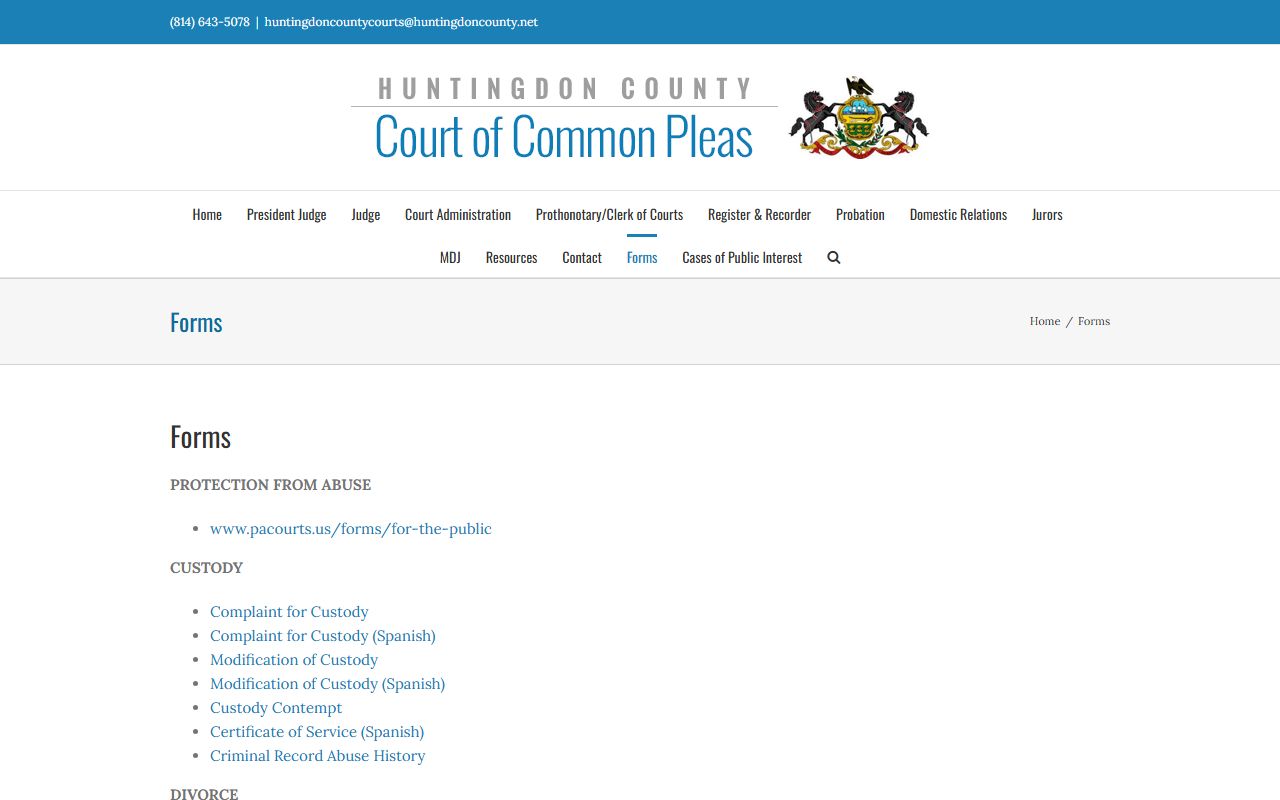
Forms are especially important when the public docket only identifies the case but does not provide the document a user needs.
How to Read a Huntingdon County Court Docket
Read from the top case identifiers first, then the entries. Confirm the court level, docket number, participant name, and case type before relying on the result. A criminal docket may show complaint, arraignment, bail, information filed, plea, sentence, restitution, costs, bench warrant entries, and final disposition. A civil docket may show complaint, service, answer, motions, orders, judgment, liens, or appeal activity. A traffic docket may show citation, plea, payment, hearing, disposition, or summary appeal status.
For criminal matters, docket sheets are not Pennsylvania State Police criminal history reports. For agency records, the county Right-to-Know process may apply. For restricted court-file material, the public access policy and court order process control. If the docket refers to a payment plan, traffic ticket, fine, cost, restitution, bail, or probation/parole fee, PAePay may show eligible obligations, but payment visibility does not prove that every docket event is current.